Sunday, 14 April 2013
Goddess Symbolism: Kuan Yin
Kuan Yin is known as the Goddess of Mercy and Compassion. She is regarded as a manifestation of the Divine Mother. Kuan Yin is worshiped in a number of religions.
Name Meaning
Literally translated, "Kwan Yin" means "The one who hears the cries of the world". Her name varies throughout different parts of the world. In Japan she is known as "Kannon", whereas in Tibet and Mongolia, her name is "Tara". In China she is called "Guanyin" but is sometimes connected with Miao Shan, a Chinese Princess known for being compassionate. She can be called upon for comfort, healing, guidance, mercy, compassion, and forgiveness.
Worship
In Buddism, she is the most important goddess and is revered as the female Buddha. This stems from the legend that Kuan Yin was once a wealthy Indian princess who chose to forsake her life of luxury to seek enlightenment, much like the Buddha did. After become enlightened and gaining the right to enter Nirvana, Kuan Yin heard a cry of suffering from someone on Earth and returned with a vow to help everyone reach enlightenment so that they too may enter Nirvana.
In Taoism, Kuan Yin is is regarded by many as the protector of women and children and is thought to be a fertility goddess capable of granting children. Some also think of her as a goddess of Luck and Fortune.
She is also popular in Wicca where she is often called upon for healing, relieving anger and negative emotions and the protection of women and children. Kuan Yin embodies the flame of mercy and compassion. She shows us how to free ourselves from all hardness of heart and teaches us to have compassion for all beings. Kuan Yin is associated with the heart chakra.
Thursday, 4 April 2013
Goddess Symbolism: Isis
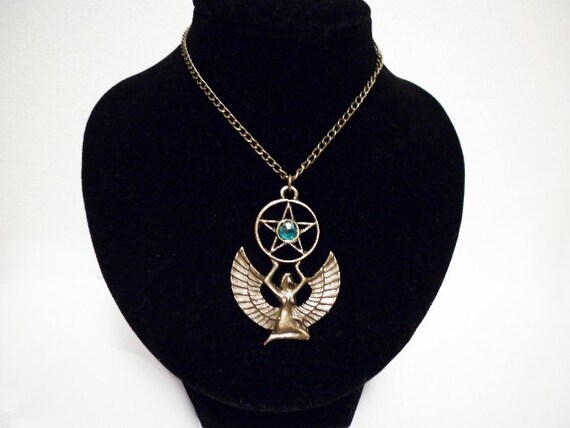
Bronze Isis Wings Necklace by Nathaira's Treasures
Isis is an important Egyptian deity, perhaps most famous for restoring life to her brother-husband, Osiris, after he was killed by his rival Set. Isis was known as the Goddess Of Magic but she is often worshiped as an ideal mother.
Origin
According to Egyptian mythology, Isis was the firstborn daughter of Geb, the Earth god, and Nut, goddess of the Sky. It is said that she possessed great magical gifts and powerful knowledge. Isis was married to her brother, Osiris. Isis's brother Set murdered Osiris and scattered parts of his body along the banks of the Nile river. She collected Osiris's remains and then used her incredible powers of healing to restored him to life and eventually granted him immortality. Isis is also mother to Horus, the Falcon-headed Egyptian god of war and protection. It is because of this that Isis is seen as the archetypal mother. The name Isis literally means "She of the Throne", a reference to her powerful position as the source of a Pharaoh's power.
Symbols
In early Egyptian imagery, Isis is seen depicted wearing a long sheath dress and crowned with a throne. However, in later times, Isis is usually shown with the headdress of the goddess Hathor, which can be described as a solar disk flanked by the horns of a cow. As Isis's popularity grew, many other goddesses were assimilated into her. Sometimes, she is depicted suckling the infant Horus. In many pictures, Isis can be seen with large wings symbolizing immortality.
Isis is an important Egyptian deity, perhaps most famous for restoring life to her brother-husband, Osiris, after he was killed by his rival Set. Isis was known as the Goddess Of Magic but she is often worshiped as an ideal mother.
Origin
According to Egyptian mythology, Isis was the firstborn daughter of Geb, the Earth god, and Nut, goddess of the Sky. It is said that she possessed great magical gifts and powerful knowledge. Isis was married to her brother, Osiris. Isis's brother Set murdered Osiris and scattered parts of his body along the banks of the Nile river. She collected Osiris's remains and then used her incredible powers of healing to restored him to life and eventually granted him immortality. Isis is also mother to Horus, the Falcon-headed Egyptian god of war and protection. It is because of this that Isis is seen as the archetypal mother. The name Isis literally means "She of the Throne", a reference to her powerful position as the source of a Pharaoh's power.
Symbols
In early Egyptian imagery, Isis is seen depicted wearing a long sheath dress and crowned with a throne. However, in later times, Isis is usually shown with the headdress of the goddess Hathor, which can be described as a solar disk flanked by the horns of a cow. As Isis's popularity grew, many other goddesses were assimilated into her. Sometimes, she is depicted suckling the infant Horus. In many pictures, Isis can be seen with large wings symbolizing immortality.
Labels:
egyptian,
fertility,
god,
goddess of magic,
goddess symbolism,
hathor,
horus,
immortality,
isis,
mother,
necklace,
nile,
osiris,
pagan,
pharaoh,
set,
sun disk,
wicca,
wings
Tuesday, 2 April 2013
Caring For Jewelry
Silver Ankh Necklace by Nathaira
Everyone loves a shiny, new piece of jewelry but the wear and tear of constant usage is enough to cause any type of metal to look dull. In order to keep jewelry looking its best, there are a few simple instructions that need to followed.
Remove Jewelry During Physical Tasks – When performing chores or other common errands, it is best to remove your jewelry to prevent breakage.
Avoid Exposing Jewelry To Liquids – It may seem like a no-brainer but exposing jewelry to water or household chemicals like bleach can cause the metal to tarnish. You should never shower or go swimming while wearing jewelry.
Store Jewelry Correctly – Keep different metals such as Gold and Silver separate when storing jewelry. It is a good idea to keep each piece in its very own airtight plastic bag to prevent any interaction with other metals. This will also prevent tarnishing as the jewelry will not be exposed to air.
Stay tuned for our next post in this series where we’ll give you tips on how to revive old or tarnished items of jewelry and get them looking new again.
Until then, feel free to visit us at: http://www.nathairastreasures.storenvy.com
Subscribe to:
Posts (Atom)